How to Deal With Your Debt and Free Up Money For a Home Purchase

Buying a house is an expensive endeavor. Although you won’t have to pay for a property in full thanks to mortgages, there is still the down payment to come up with. Plus, you’ll need to be financially sound enough to get approved for a mortgage.

But if you’re currently drowning in debt, saving up for a down payment can prove to be a tough challenge. And a large debt load may throw a wrench in your ability to secure a home loan.

If your debt situation is a little out of hand, it’s time to do something about it. Here are some tips to help you pay down your debt so you can put more of your money towards a home purchase.

Stop Spending

Sounds obvious, doesn’t it? While it might be, it’s still sound advice that is worth mentioning. The thing is, many consumers still continue on their spending rampage even though their debt issue is out of control. So, if you’re looking to deal with your debt to free up some cash to be used towards a down payment, it’s time to put a stop to excessive spending.

You’re likely in a heap of debt because of this habit, so it’s important to put a freeze on frivolous expenditures – at least for now – in an effort to throw more of your free money towards paying down your debt.

Start Tracking Your Expenses

You might not have a full understanding of how much your expenses are every month. While you might have an idea, you really don’t have an exact picture until you actually make a list of all your expenses.

One way to make this easy is to see how much you’ve spent over the past few months. This can easily be done by using your mobile banking app. If you don’t already have one on your mobile device, consider downloading one.

Banks offer expense tracking software that you can use to see where your money has been going over the recent past. Using the app (or even your online banking platform), you can view a specific date range for expenses. This will tell you how much money has been spent and where it’s been going.

Establish a Budget

Perhaps the first thing you should be doing is making a budget. You can easily and quickly find budgeting tools online that you can use which will help you make sense of your income versus expenses.

Using the information you gathered from your expense tracking efforts, you can plug these items into your budget. Your expenses may have to be categorized into “fixed” and “variable” expenses. While some monthly expenses might stay the same (such as your mortgage or car payments), others might fluctuate (such as gasoline, vehicle expenses, and medical expenses).

You’ll also want to include all the things you’ve spent money on that are outside of required expenses. This can include eating out, clothes shopping, and vacations.

For your income, be sure to include all monies coming in aside from your paycheck. This may include monetary gifts, an inheritance, commissions, tax returns, and so forth.

After you’ve added up all your expenses, subtract that number from your income. Hopefully, you’ll end up with a positive number. Anything left over should be dedicated to paying your debt down. If you’re in the red, there are obviously changes that will need to be made.

Set a Realistic Goal

The ultimate goal is to pay down your debt so that you can free up more money to put towards a down payment. But you’ll want to establish smaller, more realistic and attainable goals that will help you achieve them and gain some momentum.

Paying down your debt might not necessarily be the right goal. Instead, being very specific and establishing realistic numbers and time periods will help you inch your way toward your ultimate goal.

For instance, write down small, smart goals. This can include putting away an extra $100 on top of your minimum credit card payments for the next few months with the money that you saved from cutting down on spending. 

Make More Than Your Minimum Credit Card Payments

Speaking of minimum payments, it’s time to get out of that habit if that’s what you’ve been doing month to month. To be honest, making only minimum credit card payments is only setting you up for a trap that will become increasingly difficult to get out of. The truth is, most of that minimum payment only goes towards interest, which means you’re barely making a dent in your principal amount.

Instead, make an effort to pay more than your minimum payments. Any extra funds that you come across from reducing your spending or increasing your income should be put towards making larger payments so you can finally rid yourself of those balances that get carried over month after month.

Come Up With the Right Repayment Plan For You

Making the decision to pay down your debt and cut back on unnecessary spending can help you put more towards your debt and finally pay it down. But it helps to have a specific plan of attack when it comes to exactly how you’ll tackle this feat.

When it comes to paying down debt, there are usually two popular and effective methods that consumers are recommended to try:

Avalanche debt repayment plan – With this method, you’ll tackle your highest-interest debt first. Usually, this will be your credit cards which tend to have the highest rates among all types of loans and credit.

This method allows to you get rid of a debt that is forcing you to put more money towards interest and instead lets you save more money to pay down your principal balances. If you pay down your debt starting with the highest interest debt first, you’ll end up paying less in interest, which means you’ll pay your debts off faster.

Snowball debt repayment plan – This repayment method involves paying your smallest debt first and making minimum payments on all others, then working your way up to paying down your largest debt. This will allow you to get rid of one debt much more quickly given the smaller balance, which should give you some momentum and motivate you as you see your efforts paying off.

Once the first debt is paid off, the money that would have gone towards the first debt will then be used to pay off the next lowest debt. Carry on until you’ve paid off all debts.

The Bottom Line

Your debt situation might be a little out of control at the moment, but there are things you can do to improve your situation. Start dealing with your debt today. The sooner you do, the sooner you’ll be able to whittle your debt down to a much more manageable level. In turn, this will improve your asset base and make it easier to come up with a down payment and get approved for a mortgage.


How to Get a Mortgage When You’re Self-Employed

Getting a mortgage is a real financial feat, especially with the stringent mortgage lending criteria that borrowers have to meet these days. But securing a home loan as a self-employed entrepreneur is even tougher.

Lenders usually request the typical documents along with loan applications, such as pay stubs, employment letters, and tax receipts. But people who run their own businesses typically don’t have the same type of income information that salaried individuals do. There are no pay stubs from their employers to prove their income.

Further, each year could bring in different revenues, which can make things even more difficult to determine whether or not the borrower will be able to keep up with mortgage payments throughout the years. And if the business is less than a couple of years old, getting a mortgage is even more of a challenge.

That said, getting a mortgage as a self-employed business person isn’t impossible. It might take more work on the part of the borrower, but there are things that business owners can do to ensure their mortgage applications are approved.

Give Your Business Time to Get Established

Most lenders want to see a minimum of two years’ worth of profits in business before they approve a mortgage application. Ideally, the business you run will have been in operation – and profitable – for at least two before applying for a mortgage. Having a short business history will make it more difficult to get approved because lenders might not be as confident that you’ll be able to cover your mortgage payments every month.

If your business is new or is just starting to turn a profit, consider waiting a couple of years before applying so you can prove consistent earnings year after year, which should increase your chances of getting approved for a mortgage.

Keep Business Growing

You should ideally be in business for at least a couple of years to boost your odds of loan approval. But how your business does within this time frame matters. Having a steady income from self-employment is important. And while a little fluctuation here and there might be OK, it should follow an upward trend.

Make Sure Your Credit Score is Strong

Credit scores play a crucial role in mortgage approval. Not only do lenders want to make sure that you have the income to sustain mortgage payments every billing cycle, but they also want to ensure that your track record is clean. If you have a history of missing debt payments, your credit score will reflect these habits.

With a bad credit score, your chances of getting approved for a mortgage are small. If your credit score is currently lagging, take steps to improve it. That includes making bill payments on time, spending no more than 30% of your credit card limit, and avoiding new loan applications.

Keep Cash Reserves

Your cash flow situation might change from one month to the next, but your obligations to pay your bills every month continue. Even if business is a little slow one month, your mortgage payments will still be due and have to be made.

To compensate for potential slow months in business, it’s helpful to have a financial cushion to fall back on. With a decent reserve of cash, you can dip into this account in order to make sure your mortgage payments are covered. Some lenders may even require that you have an emergency fund readily accessible in case of slower times.

Put Forth a Hefty Down Payment

A bigger down payment means a smaller loan amount to apply for. Plus, it gives lenders more assurance that you’ll be able to make your mortgage payments every month. And if other factors of your financial life aren’t that strong, a hefty down payment amount could be what tips the scale in your favor.

Gather Up as Much Documentation as Possible

Home loan applicants need to submit a ton of paperwork to lenders as part of the application process, and the situation for the self-employed is no different. Be prepared to submit as much financial documentation as possible so your lender isn’t left with any gaps. The more documents you can gather up that prove your financial strength, the better.

Generally speaking, you should collect the following info:

  • Two years’ worth of personal and business tax returns
  • Profit and loss statement
  • Statement of assets and liabilities
  • Business bank statements
  • Business license
  • List of debts
  • Any additional income

Pay Down Your Debt

Your credit score is affected by many things, including your debt load. Too much debt could put you at risk of missing payments, which can negatively affect your credit score. On the flip side, your credit score can be improved by paying off as much of your debt as possible. Plus, it will reduce your debt-to-income ratio, which can make it easier for you to get approved for a home loan.

Keep Your Business Records Separate From Personal Finances

It will make things a lot easier for your lender if you have your personal and business financial information and accounts kept separate.

Cut Down on Tax Write-Offs

One of the benefits of owning a business is the ability to take advantage of tax deductions. Depending on the type of business that you run, you might have any number of expenses needed to run things, many of which can be written off.

But every time you deduct something from your taxes, you effectively reduce your income. But your income plays a key role in your ability to secure a mortgage. The lender wants to make sure that you earn enough to afford a loan.
To give your income a bit of a boost, consider writing off less on your tax return. Just be very careful about how you approach this tactic and speak with a tax specialist first. 

The Bottom Line

It might be a challenge to have your mortgage application approved if you’re self-employed, but it’s certainly not impossible. Be sure to do what you can to strengthen your credit rating and financial situation, and get all the proper documentation together when applying to boost your odds of mortgage approval.

Tips For Buying a Rural Home

City dwelling definitely has its perks. There are plenty of employment opportunities around, amenities are within close proximity, and entertainment is usually pretty vibrant.

But there’s something alluring about living far outside the city limits that might have you contemplating a change of pace. Perhaps you’re looking for more space, a little less noise, and definitely a lot less traffic. Whatever your reason is for going rural, there are some things you should contemplate first before making the move.

Here are some tips for buying a home in the rural outskirts.

Look Into Specialized Mortgage Products

There are different mortgage products available for different types of buyers and properties. Since you’re considering buying a rural property, there may be mortgage products out there specifically for this type of real estate.

More specifically, look into USDA financing options. The USDA – or the United States Department of Agriculture – offers loan products for those looking to buy in rural areas.

These types of mortgages have specific criteria that both the borrower and the property must meet. USDA mortgages are actually pretty popular among buyers who purchase rural properties. Be sure to work with a lender who is familiar with these products and is able to explain them in great detail before you decide to go with this product.

Decide on an Exact Location

There are different options in terms of exact locations when searching for a home in a rural area. For instance, do you want to have vast open land, or would you prefer a wooded lot? Do you like the idea of backing onto a creek, or do you like the idea of completely dry land better?

Before you start looking around for a rural property, think about the type of setting you’d like to have with your land.

Determine the Size of Land You Want

Not only is the lot’s setting important, but so is the amount of land that you want. Just because you’re buying in the rural outskirts doesn’t mean that you’ll be sitting on acres and acres of land.

While that might be exactly what you want, there are other options. In addition to acreage, you can look at homes that sit on smaller parcels of land, depending on your needs and desires. Lot size is certainly an important factor to decide on before you start house hunting.

Consider the Utilities

Unlike the city where homes are serviced by sewer systems and trash is collected by the city, rural properties don’t get this type of attention. Instead, you’ll be looking at septic systems, well water, or oil/propane heating. Make sure that whatever type of system services the home, it’s adequate enough.

For instance, is the septic system able to accommodate the size of the home and all the occupants who will be living in it? Septic systems are only able to handle a certain number of people living there. Similarly, make sure the well water system is appropriate and the water quality is adequate.

Find Out if the Road is Private

Determine whether or not the road that the property abuts is private or not. If it’s owned by the city, then you won’t have to worry about maintenance. But if it’s a private road, then the responsibility lies on you. Consider the time and effort this will require, as well as the expense.

Hire an Agent With Experience Buying and Selling in Rural Areas

Buying a rural property is somewhat different than buying a home in the city. There are clearly additional factors to consider that you wouldn’t have to worry about when buying in an urban center.

Considering all the nuances involved in buying a rural property, it would be in your best interests to make sure that you hire an agent who is well-versed in the purchase and sale of these types of properties. Without a seasoned agent in your corner, you won’t know about any documents or legal issues that may need to be a part of the real estate contract.

The Bottom Line

Buying a home in the rural parts of town can afford you with plenty of space, a lot less pollution, and more peace and tranquility. But there are a few extra details that come with the purchase of a rural real estate that you should be familiar with before you begin your search. Make sure you understand what these are so you make the right move.

Open House Etiquette For Sellers

Open houses provide sellers with a great opportunity to showcase their home to the general public in hopes of finding a willing buyer to put in an offer. While not mandatory, open houses can be a great way to generate interest among buyers and give them a chance to check out your home without having to commit to a private showing.

But how the open house is conducted and what you do as a seller can heavily influence the success of your open house. To help you make the most of your open house, there are a few rules of etiquette that you should follow as a seller.

Don’t Stay

Buyers want to have the freedom to walk through the home freely without thinking that the seller is watching them like a hawk. They want to be able to open all doors and drawers without feeling like they’re invading the owner’s privacy. They also want to have the liberty of making comments about the place – both positive and negative – which they probably wouldn’t do if the seller was present.

You’re holding an open house for a reason: to find a buyer. But if you’re there, you’re limiting potential buyers’ ability to check out your home in great detail.

It’s common for sellers to leave the premises while their homes are being opened up to the general public. So when it’s time for your open house, make plans to be anywhere but at home.

Take Your Pets With You

Your home is just as much your furry friend’s as it is yours. But during your open house, your pets should vacate the premises just like you should. This is a good idea not just for buyers, but for your pet’s safety as well.

Some buyers might have an affinity for animals, but others might not. Your pet could be a major distraction during your open house. Plus, animals don’t exactly do much for the decor and smell in a home. Your pet may have a distinct odor that many buyers might not appreciate. Animals could also leave behind a mess that buyers might be turned off by.

Your pet can also be put in harm’s way if you leave them there without you to supervise. The front door will be opened and closed a number of times as prospective buyers enter and exit the home. Your pet could easily escape whenever the door is opened. Do yourself, your pet, and buyers a favor and take your pet with you while your home is open to the public.

Clean Up the Place

While your home is on the market, it should be in pristine condition at all times. This is true both for showings and for your open house.

Before you leave your home for a few hours during your open house, make sure that you’ve cleaned up the place, put away everything in their proper places, and polished all surfaces. Leave out a bouquet of flowers or two to sweeten the smell in your home while you’re at it to make a better impression.

Offer Some Direction

If your home is a bit difficult to find – especially for buyers who aren’t familiar with your area – make sure there are plenty of signs that are clearly positioned at both major and minor roads and intersections to help buyers find your home. To make the signs even more noticeable, attach some helium-filled balloons to them. Proper signage can attract a lot more buyers to your open house.

Keep Cars Out of the Driveway

Don’t leave any of your cars on the driveway during your open house. Instead, leave these spaces open for buyers who come to visit.

Further, make sure to ask your neighbors to move any cars they may have parked in front of your home to give buyers even more space to park in case your open house is a busy one.

Put Out All Important Documents

To help prospective buyers get all the information they need to make an informed decision before putting in an offer on your home, leave out pertinent documentation that they’ll have easy access to. This includes any paperwork related to home inspections, appraisals, permits for renovations, utility bills, surveys, and so forth.

The Bottom Line

It takes a lot of effort on your part and on the part of your agent to put an open house together. You just never know if one of the visitors who shows up will be the one to put in a solid offer. Be sure to follow these seller etiquette rules to boost the odds of a successful open house.

7 Things That Are Left Behind When You Sell

When it’s time for you to move out of your old home and into your new one, there’s a lot of packing and hauling to do. But while you’ll obviously want to take all your clothes and furniture with you, there are certain items that you should leave behind.

Certain things are just assumed to remain with the property when sellers move. And if buyers find that these things have been taken on move-in day, there could be trouble.

As a general rule of thumb, the following items should be left behind when you move out.

1. Light Fixtures

When buyers scope out a new house to buy, they usually assume that the light fixtures they see in the home will stay when they move in. Unless you specifically state in the contract that you want to take the light fixtures with you, they should stay with the home.

If you do take them, it’s customary to replace them with something else so the buyers aren’t left with dangling wires and gaping holes in the ceilings and walls.

2. Anything Secured to the Ground

If it’s stuck to the ground, odds are it should stay with the property when you move. This can include any of the following:

  • Mailboxes
  • Fences
  • Lights
  • Fountains
  • Water features
  • Fire Pits
  • Gazebos

Hot tubs should also stay even though they might not necessarily be affixed to the ground. There are still plumbing pipes and electrical wiring that are typically installed in hot tubs and run in-ground, so technically these structures should probably stay with the home too.

Items like these that are secured to the ground are technically classified as real estate as opposed to personal property, so they should remain on the premises when you vacate. If you have your heart set on taking a certain item with you, clearly detail its exclusion in the contract and make sure both you and the buyer initial it (if the buyer agrees).

3. Outdoor Plants

Along the same lines as the items listed above are outdoor plants, shrubs, flowers, and trees. Basically, any greenery that you have planted outside is considered to be part of the property and should remain there when the buyers move in. Buyers would be unpleasantly surprised to show up on moving day only to find large holes where plants once were.

Any greenery that has established deep roots would likely die after being ripped out of the ground and planted elsewhere anyway, so you would be better off leaving them where they are.

4. Anything Affixed to the House

Any items that are affixed to your home are also considered part of the property. This includes things such as:

  • Hot water heaters
  • Radiators
  • Bathtubs
  • Plugs
  • Built-in shelves
  • Cupboards

While it might sound silly to even try to rip any one of these items out and take them with you, it can and does happen. In these cases, buyers are left annoyed at the situation and sellers often wind up in legal trouble. As a general rule of thumb for sellers to follow, anything that is affixed to the home usually stays.

5. Fittings

Certain items might not necessarily be affixed to the property, but they should probably stay with the home anyway. This includes things such as the following:

  • Carpets
  • Curtains
  • Curtain rods
  • Free-standing appliances, such as refrigerators, ovens, and washing machines
  • Satellite dishes

6. Manuals

Certain items in the home usually come with manuals when you first buy them. These manuals contain details needed for proper set-up when you first buy or install them as well as troubleshooting tips in case there’s ever a problem.

Having these manuals handy is important not just for you, but for buyers who may be taking over your home. Things such as refrigerators, ovens, hot water heaters, dishwashers, or any other item that is remaining on the premises will likely have manuals. Make sure to leave these behind for the buyer, and keep them in plain sight so they don’t have to go searching for them when they need them.

7. Extra Paint

When buyers first move into a new home, they may want to do some touch-ups on the walls here and there if there are any scuff marks that need to be covered. They may even need to do that from time to time long after having moved in. When that happens, having the exact paint handy can really help.

It can be nearly impossible to match the exact paint color on your walls with paint purchased in-store without knowing the precise one that was used. While you could always leave the exact brand name and paint color model number behind for the buyers, it would be much easier for them if you just left any leftover paint cans that you might still have.

The Bottom Line

If there are any items that you really want to take with you that would otherwise be left behind, make sure you take care of these details during the actual negotiation process so there are no surprises. Make sure everything is in writing. But in general, anything that is bolted, mounted, nailed, or planted into the home or ground should probably stay.

How to Use Your Home Equity to Consolidate Debt

There are plenty of benefits to owning a home. For starters, you have full control over your property as an owner compared renting. Owning a home also provides you with a way to invest your money and take advantage of appreciation in value over time.

But as it turns out, owning a home might even provide you with a way to effectively deal with your mounting debt. If you’ve got a certain amount of equity built up in your home, you might be able to access it to consolidate your debt.

Why Consolidate Debt?

If you’ve got a lot of different loan payments to make every month, you know how much of a challenge it can be to manage them all and make sure they’re paid on time. It can be a real nuisance to constantly find a new bill in the mail every few days after you thought you tackled the last one for the month.

Not only that, but some of those bills can come with sky-high interest rates. The higher the rate, the more expensive your debt will be. Credit cards, in particular, are notorious for charging super high rates. If you only make minimum payments every month, that outstanding balance will just grow, making it increasingly difficult to pay that debt down.

If you’re finding yourself drowning in mounting debt, consolidating it might be a great option. By consolidating your debt, you can essentially combine it all into one larger, easier-to-manage debt. And with a lower interest rate, that debt can be more affordable, which will allow you to pay it down faster.

As a homeowner, you have the unique ability to borrow against the equity in your home to be used for all sorts of things, including consolidating your debt. So, how exactly is this done?

Home Equity Loans For Debt Consolidation

Through a home equity loan, you can use the equity you’ve built up on your home to be used to consolidate your high-interest debt. With timely mortgage payments, appreciation in value, or a combination of the two, you might have more equity in your home than you think.

A home equity loan is basically a loan that’s secured against the equity in your home. You’ll receive a lump-sum amount that you can use to consolidate your debts.

Home equity is defined as the difference between the value of your home and the amount that you still owe on your mortgage. So, let’s say your home is currently valued at $600,000. If you still owe $400,000 on your mortgage, that means you have $200,000 in equity. While this is a simplified calculation, it gives you an idea of what home equity is.
Lenders usually require that borrowers have at least 80% equity in their homes before approving a home equity loan. So, in the example above, you would have more than enough equity to qualify for this requirement. That said, there are other criteria that you’ll need to meet, including having a decent credit score (at least 680) and a sufficient income to support additional loan payments.

If you are approved, you can use the money from your home equity loan to pay off all your creditors and lenders. Then, you’ll be left with just your home equity loan payments.

If you can secure a home equity loan with an interest rate that is significantly lower than some of the rates you were being charged on your other debts that you paid off, you can save money and make it easier to pay down your debt sooner.

The Bottom Line

A home equity loan can be a great way to get your hands on the money needed to pay off all your current lenders and creditors and end up with only one, lower-interest debt payment. If you own a home and have some equity accumulated, this financial arrangement might be suitable for you.

Just make sure that you are financially comfortable with making these payments. If you default on your home equity loan payments, you risk losing your most valuable asset – your home – since this loan is collateralized by your house. As such, be sure to take the time to verify whether or not your current finances can support these monthly payments.

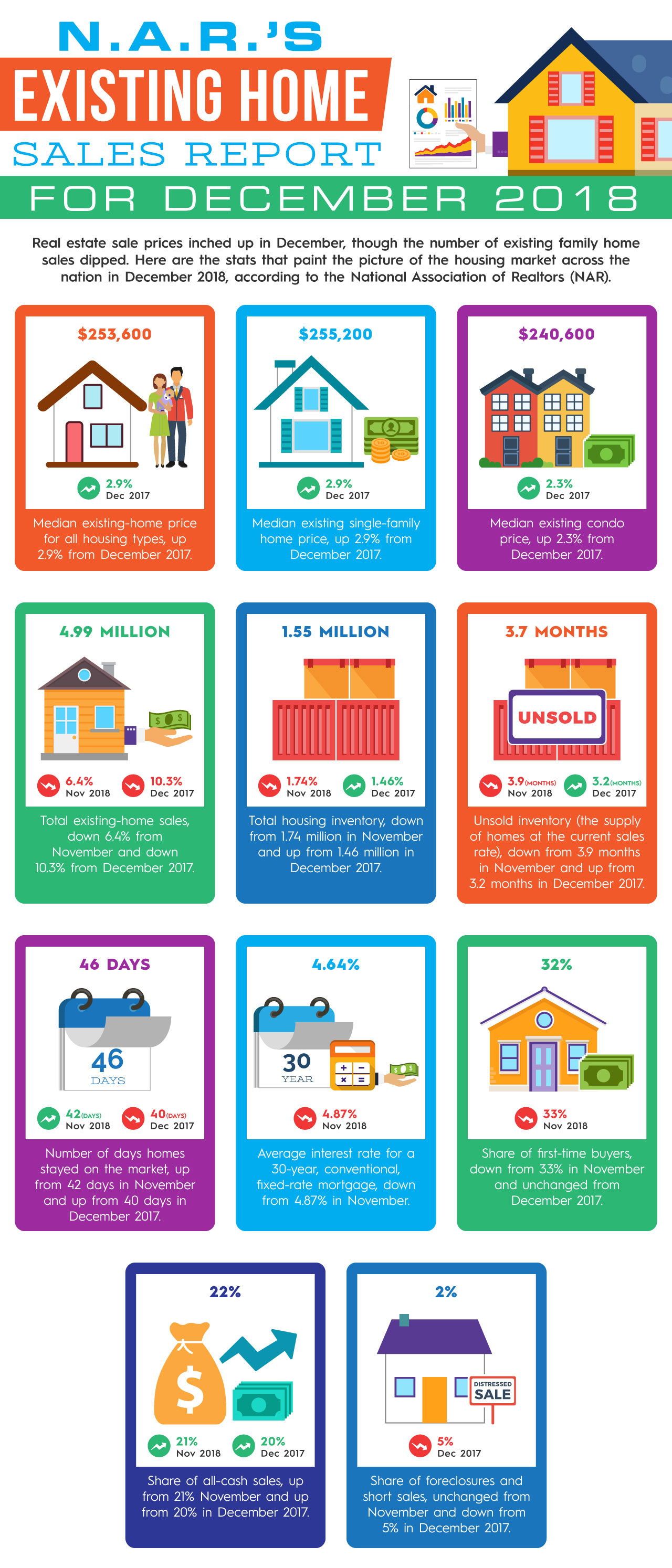
INFOGRAPHIC: NAR’s Existing Home Sales Report For December 2018

Buying and Selling at the Same Time? Follow These Tips

If moving is on the horizon for you sometime soon, then you’ve got plenty of decisions to make. And one of these important decisions is whether to sell or buy first.

Should you list your home first and look for a willing buyer before committing to another home? Or should you find something first to make sure you’ve got a place to go if you happen to sell faster than you initially thought?

Many homeowners are usually torn when it comes to making this decision, so the typical solution is to simply buy and list at the same time. The thing is, coordinating closing dates on both the sale of your current property and the move-in date of your new home can be a real challenge.

So, how can you make sure that buying and selling at the same time works out for the best? Consider following these tips.

Determine the Market You’re in

The temperature of the housing market in your area will determine how to proceed with your move. In fact, this is perhaps the most important factor to consider when timing your purchase and sale perfectly. The amount of time it takes to sell versus how much time it will take you to find the right home to buy will need to be considered when timing it correctly.


Is it a buyer’s market? If so, that means there are plenty of sellers out there and lots of inventory for buyers to choose from with fewer buyers to compete with. In this market, finding a home at a good price shouldn’t take long at all, though selling might take a little longer.

Is it a seller’s market? Then that means there are tons of buyers to compete with and not much inventory, which could take you longer to find the right property. But as a seller, you have a better chance of finding a buyer quickly and sealing a deal on your current home in a short time frame.

If you decide to list your current home and look for a new property at the same time, make sure you take the current market into consideration. Your listing strategy and house-hunting tactics should be tweaked accordingly to try and get the timing right.

Get Pre-Approved For a Mortgage

It’s always a good idea for buyers to get pre-approved for a home loan before they start house hunting. This will help them get an idea of how much they can afford in a home purchase. A pre-approval letter will also help get the ball rolling with mortgage approval so the mortgage can close faster after a deal is reached. This is important if you’ve sealed a deal on your current home and need to close faster.

A pre-approval is particularly important if you’re a buyer in a seller’s market, as you’ll be competing with many other buyers for fewer homes. In this case, you’ll want to do whatever you can to bring a purchase deal into fruition without any hiccups, and being pre-approved for a mortgage can help.

Have an Appraisal and Inspection Done on Your Current Home

Getting your home appraised before you list will help you determine the best listing price for your home. Inflated listing prices can end up causing listings to linger on the market for longer than necessary, causing them to go stale. An appraisal will provide you with some great insight into what your home is actually worth according to market conditions and will help you price accordingly.

Having your own home inspection done before buyers first make their way into your home to scope it out will help you identify any issues that may need some attention. Knowing about any potential defects with your home will give you the opportunity to fix them before your property is listed. You can be sure that such defects will be identified in a buyer’s home inspection, so uncovering them before an offer is agreed on can make the sale go much smoother.

Both an appraisal and a pre-listing home inspection can help you get your home ready for the market and price it accordingly, which can both prove to be extremely helpful in ensuring a seamless transaction.

Consider Including a Contingency to Sell Your Home First

If you find yourself in a buyer’s market, buying a new house shouldn’t be an issue. But selling might take a bit longer. In this case, you could find yourself with two mortgages to pay if you can’t sell your home after committing to buying a new one. In this case, you may want to consider including a contingency in your offer on a new home that states that you’ll only buy the home if you’re able to sell your existing property.

Just keep in mind that many sellers might not be too keen on such a contingency and may reject it.

Hire an Experienced Real Estate Agent

Your best bet when trying to time the purchase of a new home and the sale of your current property correctly is to hire a seasoned real estate agent who’s experienced with these situations. Trying to time these two transactions can be a complicated endeavor, so working with an experienced agent can prove to be extremely helpful.

An agent who is well-versed in these situations can help you come up with a sound strategy, negotiate appropriately, and price right to ensure that the timing of both transactions is as seamless as possible.

The Bottom Line

Lining up the closing dates on the sale of your current home and the purchase of a new one can be a real challenge. When you’re ready to make a move, make sure you go into this situation with a sound plan of action and a seasoned real estate agent in your corner.

What Exactly Do Your Condo Fees Cover?

Condo living is pretty popular among buyers who are looking for something more affordable than traditional freehold homes. Plus, there are a bunch of other perks to living in a condo beside their more affordable purchase prices, including their amenities, low maintenance, and 24-hour security.

But your mortgage isn’t the only monthly payment you’ll have to make when you own a condo. Unlike a traditional freehold house, condos also come with monthly condo fees that every owner in a complex must pay.

The amount that each owner is responsible for paying is based on a specific rate multiplied by the square footage of their respective unit. You could pay as little as $200 to as much as $1,000+ in condo fees every month, depending on where your condo is located, the type of building it is (ie. luxury condos usually charge higher fees), and the type and number of amenities offered.

The question is, what exactly do monthly condo fees cover?

Security

Most condo buildings staff a 24-hour concierge who will serve as security, as well as a point of contact for things like visitors, mail, minor issues, and so forth. The concierge or security guard’s paycheck is typically covered by funds collected from monthly condo fees.

Maintenance of Common Areas

Every owner is responsible for maintaining their own individual units. But the maintenance, cleanliness, and repair of all other common areas of the building are paid for via condo fees. This includes the maintenance of things such as:

  • Landscaping
  • Parking garage and lot
  • Elevators
  • Hallways
  • Fences
  • Walls
  • Gates
  • Windows
  • Rain gutters
  • Heating and cooling systems
  • Gas pipes
  • Electrical systems

Maintenance of Amenities

In addition to the common areas and systems just mentioned, condo fees also cover the maintenance of the building’ amenities, which differ from one condo complex to another. That said, common amenities in condominiums may include:

  • Game rooms
  • Fitness rooms
  • Saunas
  • Swimming pools
  • Party rooms
  • Rooftop gardens
  • Guest suites

Insurance

Not every condo complex includes insurance as part of what their condo fees cover but must do. The insurance policies that condos take out cover building exteriors and shared common areas. Sometimes they might extend to cover things like damage done by floods, fires, and earthquakes. Given this, unit owners are only responsible for taking out an insurance policy to cover the interior of their own units and their personal belongings.

Reserve Fund

A reserve fund is an emergency fund, so to speak, that is saved up to cover the cost of occasional and unexpected repairs. For instance, a new roof or a newly paved parking lot are not things that must be done every year. Instead, they occur on occasion, and the money in a reserve fund can then be applied to cover these costs.

Ideally, there will be enough money in the reserve fund to adequately cover these costs. If not, each unit owner will be forced to fork over a lot of money in order to make up the difference between what’s in the reserve fund and how much needs to be spent.

A condo board that is well-run will charge each owner a small amount every month to be put towards keeping the reserve fund well-padded. That way, when the money is needed, there will be no need for owners to have to pay much more than they’re already responsible for paying every month.

Utilities

The majority of condo fees cover the cost of certain utilities of the building, including (cold) water, garbage collection, and sewers. Some may go so far as to cover heat, electricity, and hot water, and some may cover everything. Every building is different, so you’d need to check with your specific condo to find out exactly what your fees cover.

The Bottom Line

There are plenty of things that you have at your disposal when you live in a condo. But such things aren’t free; instead, you’re paying for them through monthly condo fees. If you’re in the market to buy a condo, make sure to find out exactly how much the condo fees are and what they cover before you sign on the dotted line.